
From ‘shaped by Others’ to ‘shaped by China’: Song Yuehong on New China Studies

Song Yuehong Photo: PROVIDED TO CSST
For more than two decades, Song Yuehong, deputy director of Institute of Contemporary China Studies under the Chinese Academy of Social Sciences (CASS), has devoted himself to the study of the national history of the People’s Republic of China (PRC), guided by a commitment to “writing the history of the nation, recording the lives of the people, and illuminating the virtues of the times.” Recently elected as a CASS Member, Song approaches his scholarship as part of the broader undertakings of the Party and the state.
Researchers of the PRC’s national history, he says, must uphold Marxism as their guiding principle and ground their work in Chinese practice to answer the “four questions”—questions of China, the world, the people, and the times. Through scholarship that stands the test of history, practice, and the people, they must contribute to the flourishing and development of philosophy and the social sciences with Chinese characteristics.
Anchoring research in mission of the times
CSST: Congratulations on your election as a CASS Member. In your view, what is the mission of studying the PRC’s national history in the new era?
Song: Election as a CASS Member is a distinguished academic honor, but it also carries a profound responsibility to the times. History is the foundation upon which a country and a nation establish themselves. Cultivating a correct view of history is an essential prerequisite for forming a scientific worldview and outlook on life. The national history of the PRC connects yesterday, today, and tomorrow—it looks back on past practice while illuminating present development and anticipating future trajectories.
The study of the PRC’s national history in the new era should be guided by the Marxist theory of social formation, ground itself in the actual motion of social contradictions in contemporary China, reveal the evolutionary thread of the Sinicization and modernization of Marxism, summarize the Party’s achievements and experience in governance, explore the underlying patterns of China’s economic and social development, and deepen and expand research on the theoretical system of Chinese modernization. It should firmly grasp the principal theme, main thrust, and essential nature of the PRC’s national history, explain the historical inevitability of Party leadership, reform and opening up, socialism with Chinese characteristics, and the great rejuvenation of the Chinese nation, consolidate the historical foundations of the “Four Matters of Confidence” [confidence in its path, confidence in its theory, confidence in its system, confidence in its culture], and provide a powerful intellectual force for national development and the progress of human civilization.
The study of the national history of the PRC, as a discipline, is both foundational and applied. Serving the broader agenda is not an empty slogan—it must be translated into concrete scholarly practice. First, the discipline should maintain a firm political stance, consciously align with the CPC’s series of arrangements for research on Party history and the history of New China, and take the leadership’s important expositions on historical science as the fundamental guide. Second, it should uphold a policy-advisory orientation, draw scholarly topics from major theoretical and practical issues of the state, and transform historical experience into historical wisdom. Third, it should hold fast to the battlefield of struggle, take a clear-cut stand against historical nihilism, and conduct scholarly research on safeguarding national sovereignty, security, and development interests. Scholarship cannot be divorced from the times. The patriotic commitment of researchers of the PRC’s national history is embodied in integrating individual scholarly pursuits into the grand cause of building a strong nation and achieving national rejuvenation.
Deepening theoretical construction
CSST: You have proposed “the philosophy of the national history of the PRC” as a new research direction, introducing the philosophy of history into the study of the PRC’s national history. How does this contribute to building an independent knowledge system for the study of the PRC’s national history?
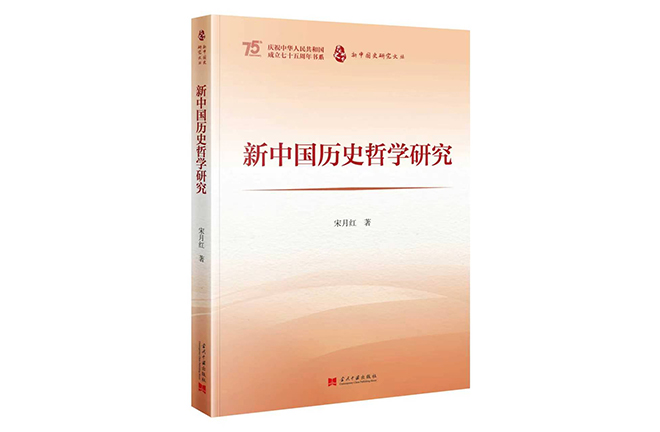
Song: The philosophy of the national history of the PRC constitutes the ontology, epistemology, and methodology of the history of New China. It takes the historical process of New China and its objective laws as its research object, probes the deep philosophical propositions of the history of New China under the guidance of historical materialism, develops a perspective and theories of the PRC’s national history, and guides the entire chain of research, compilation, public communication, and education regarding the PRC’s national history. Traditional national history research has focused largely on factual narration and textual criticism of historical sources, primarily answering the questions of “what happened” and “how it happened.” The philosophy of the PRC’s national history presses further into fundamental questions: Where did New China come from, and where is it heading? What kind of New China should be built, and how should it be built? It elevates historical facts to the philosophical level for reflection and inquiry.
Developing the philosophy of the PRC’s national history deepens the theoretical construction of the history of New China itself. It also provides a philosophical foundation for “New China studies,” supports the construction of China studies in the new era, and contributes Chinese historiographical thought to civilizational exchange and mutual learning.
CSST: You have proposed that the study of the PRC’s national history should advance toward “New China studies” and that China studies should shift from being “shaped by others” to being “shaped by China itself.” What is the scholarly logic behind this intellectual vision?
Song: The study of the history of New China and “New China studies” are complementary and mutually reinforcing. The study of the history of New China takes “history” as its primary axis, focusing on narrating historical processes, verifying historical sources, and identifying underlying patterns. “New China studies” is “scholarship on New China.” It encompasses the entire body of knowledge concerning New China, much like an encyclopedia, presenting a comprehensive picture of its history and realities, its theories and practices, and its interactions with the wider world.
For much of the modern era, “China studies” within international academia was dominated to a large extent by Western discourse, producing a narrative “shaped by others.” In fact, China is the homeland of “China studies.” The understanding of New China’s historical patterns that the CPC has developed through more than a century of practice provides the intellectual foundation for explaining Chinese practice through Chinese theories and elevating Chinese theories through Chinese practice. The Chinese people are best positioned to grasp their own history and realities.
As China moves ever closer to the center of the world stage, China studies should shift from externally generated knowledge and being “shaped by others” toward self-confidence and being “shaped by China itself,” strike a balance between domestic and international scholarship, and engage in civilizational exchange and mutual learning. Developing “New China studies” requires formulating independent concepts, theories, and narratives, moving beyond Western frameworks, and extracting distinctive scholarly categories from China’s historical practice. This is an important undertaking in building an independent knowledge system of Chinese philosophy and social sciences.
Maintaining scholarly autonomy does not mean closing oneself off and excluding others. New China studies is, in itself, scholarship of mutual learning among civilizations. It should be rooted in China while engaging with the wider world, focus on the “four questions,” deepen research on the “Two Integrations” [integrating the basic tenets of Marxism with China’s specific realities and its fine traditional culture], and secure scholarly initiative through dialogue and exchange.
CSST: Looking back on your academic trajectory, what experiences shaped your scholarly conviction of “writing the history of the nation”? What guiding principles have remained consistent throughout your research?
Song: Although my research spans multiple fields and covers considerable intellectual ground, the internal logic is highly coherent: Party history is the soul of the PRC’s national history; Tibetology ultimately serves the goal of safeguarding national unity and ethnic solidarity; and broadening the horizons of the study of the PRC’s national history contributes to forging a strong sense of community for the Chinese nation.
Research across different fields can be guided by a common set of scholarly principles. First, it should always uphold historical materialism and adopt a rational outlook on the Party’s history, cultivate a grand conception of history and nation, and proficiently apply Marxist standpoints, viewpoints, and methods to analyze historical and contemporary issues. Second, research should be grounded in historical facts, attach importance to textual criticism of primary archival sources, ensure that arguments are derived from evidence, insist on systematic and integrative research, and reject subjective conjecture. Third, it should pursue interdisciplinary integration, combine macro-level narratives and micro-level examination, strengthen problem orientation, and integrate basic research, applied research, and policy advice.
Future research priorities
CSST: Following your election as a CASS Member, what will be your research priorities as a leading scholar in your discipline?
Song: I will focus on advancing four major research priorities. First, I will engage in research on a general history of New China’s political system, tracing the historical logic of the formation and development of the PRC’s fundamental and basic systems. Second, I will advance research on the historical evolution of the PRC’s administrative divisions, drawing on multidisciplinary approaches to address gaps in historical geography in the study of the PRC’s national history. Third, I will deepen research on the history of the Party’s thinking on governing, stabilizing, and developing Xizang, on the practice of “One Country, Two Systems,” and on the histories of Hong Kong, Macao, and Taiwan, consolidating the historical and jurisprudential foundations of China as a unified multi-ethnic country and deepening historical and theoretical research on forging a strong sense of community for the Chinese nation. Fourth, I will broaden and deepen New China studies in the new era, ground my work in China’s standpoint, values, and national spirit, bridge China’s history and its contemporary realities, and formulate scholarly concepts that address major global issues while reflecting Chinese wisdom, presenting a true, multidimensional, and comprehensive picture of China to the world and accelerating the development of an independent knowledge system for the study of the national history of the PRC.
Edited by YANG XUE