
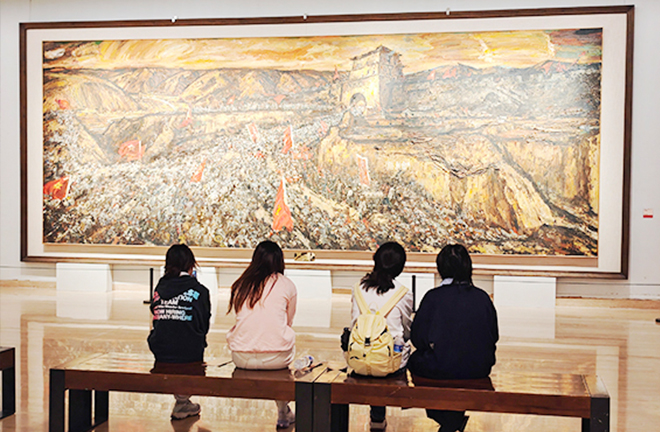
“Magnificent Epic: Art Exhibition Commemorating the 90th Anniversary of the Victory of the Long March of the Chinese Workers’ and Peasants’ Red Army” opened at the National Art Museum of China on Sept. 29. Photo: Lyu Jiazuo/CSST
The year 2026 marks the 90th anniversary of the victory of the Long March of the Chinese Workers’ and Peasants’ Red Army. Ninety years ago, under the leadership of the Communist Party of China (CPC), the Red Army brought the Chinese revolution back from the brink and opened a path forward, creating an epic of courage and endurance in the annals of human history. Today, commemorating that journey means honoring the martyrs and veterans who contributed to national independence and the liberation of the people, carrying forward the great spirit of the Long March, and continuing the pursuit of national rejuvenation—a new Long March—with achievements worthy of earlier generations and the present era.
A historic turning point
Dong Jia, a professor from the School of CPC History and Party Building at Renmin University of China, told CSST that the Long March was, in essence, the CPC’s response to a critical historical juncture when both the future of the Chinese revolution and the fate of the Party itself hung in the balance. “By marching northward to Shaanxi and Gansu provinces, the CPC sought a base where it could survive and from which it could spread the seeds of revolution across the country. The march brought a strategic shift from south to north, accompanied by a change in revolutionary priorities—from the land revolution in the Soviet base areas to mobilizing nationwide resistance and establishing a national united front against Japanese aggression. In this sense, the Long March marked a pivotal transition, linking successive stages of the Chinese revolution.”
The victory of the Long March demonstrated the CPC’s unyielding fighting spirit to China and the wider world, said Ouyang Xuemei, a research fellow from the Institute of Contemporary China Studies at the Chinese Academy of Social Sciences, adding that it led a growing number of people to place their hopes for national rejuvenation in the Party.
The Zunyi Meeting marked the beginning of a new stage in which the Party independently addressed the practical problems of the Chinese revolution. At the moment of greatest peril, it saved the Party, the Red Army, and the Chinese revolution. “Without independence and self-reliance, there can be no genuine revolution or liberation,” said Cao Pengfei, a professor from the Department of Party Building at the Party School of the CPC Central Committee (National Academy of Governance). “Political independence, organizational independence, and independence of action constituted a necessary ‘rite of passage’ for the Chinese revolution and the CPC to achieve their goals.”
Liu Jianping, a professor from the School of Marxism at Xiangtan University, identified several fundamental reasons for the Long March’s victory: the Party’s correct leadership, which provided the essential political and organizational guarantee of victory, adherence to the principle of seeking truth from facts, close reliance on the people, the iron will of Red Army officers and soldiers, and the rapid achievement of unity throughout the Party and the army.
A defining legacy in the spiritual tradition of Chinese Communists
Pu Duanhua, dean of the Political College at the PLA National Defense University, attributed the Party’s and the Red Army’s repeated recovery from setbacks to their unwavering commitment to lofty ideals and revolutionary convictions. Those ideals and convictions inspired a resolve to fear neither hardship nor death in pursuit of revolutionary victory. They also guided practical action grounded in reality, linking lofty aspirations with efforts to solve concrete problems.
Wu Weiguo, a professor from the School of History at the University of Chinese Academy of Social Sciences, is the son of Wu Zhiyuan, who took part in the Long March. Speaking with CSST, he recalled that his father injured his foot while crossing the marshlands. For three days, his regimental commander and political commissar took turns letting him ride their horses, enabling him to complete the crossing. “The victory of the Long March owed much to the solidarity of officers and soldiers, who helped one another overcome extreme hardship.”
Across the regions traversed by the Red Army, countless moving stories endure of the bond between soldiers and civilians, including “Half a Quilt” and “A Sack of Rations.” Wang Hongshu, a professor from the College of Marxism at Sichuan University, noted that the victory of the Long March was a victory for the people. However harsh the conditions and however hostile the environment, the Communists maintained strict discipline and persevered, winning widespread popular support and building a firm foundation for revolutionary victory.
Yan Wenbo, a professor from the School of Marxism at Jiangxi Normal University, said that the spirit of the Long March draws its guiding principles from Marxism. Its core qualities—independence and self-reliance, seeking truth from facts, and the mass line—embody the Marxist position, outlook, and methodology. Rooted in fine traditional Chinese culture, it expresses the political ideal of “pursuing the common good for all,” the people-centered conviction that “the people are the foundation of the state,” and a commitment to “ceaseless self-improvement.” These qualities give core socialist values their distinctive character. With national rejuvenation as its overarching goal, the Long March spirit also provides spiritual support for building a consensus on the values underpinning that endeavor.
Ban Xiaoyue, Zha Jianguo, Ming Haiying, and Chen Lian contributed to this story.
Edited by WANG YOURAN