
Scholars reflect on Long March legacy
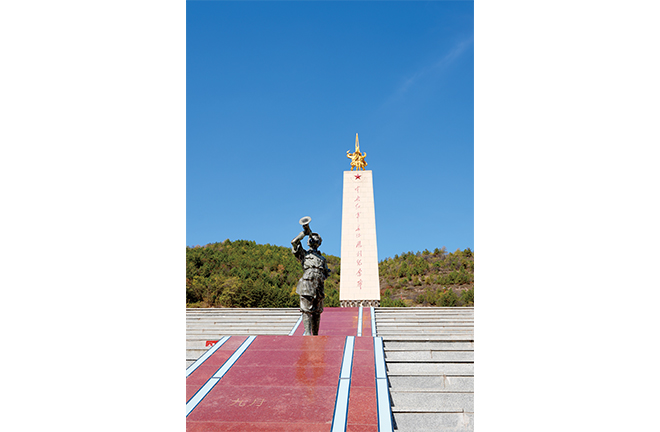
A ceremony marking the 90th anniversary of the victory of the Long March of the Chinese Workers’ and Peasants’ Red Army was held in Beijing on Oct. 22. Xi Jinping, General Secretary of the CPC Central Committee, president of the People’s Republic of China, and chairman of the Central Military Commission, attended the ceremony and delivered an important speech.
In the days since, scholars of philosophy and the social sciences nationwide have studied his address, affirming the need to accelerate the development of an independent knowledge system of Chinese philosophy and social sciences under the guidance of Xi Jinping Thought on Socialism with Chinese Characteristics for a New Era. They also called for scholarship that contributes to building a great modern socialist country and advancing national rejuvenation.
Understanding the keys to the Long March’s victory
General Secretary Xi Jinping said that victory in the Long March was inevitable and that the march itself embodied the sources of strength behind the success of the Party and the people’s army. Reflecting on the path to victory, Xi identified four key factors: the Party’s correct leadership, firm revolutionary conviction, independence and a commitment to seeking truth from facts, and the support of the people.
Hong Xianghua, a professor from the Party School of the CPC Central Committee (National Academy of Governance), said the history of the Long March demonstrates that the Party’s firm, correct leadership and the establishment of Comrade Mao Zedong’s leadership were decisive in enabling the Red Army to escape desperate circumstances and achieve victory. A strong leadership core and scientific theory remain essential to navigating the risks and challenges of today’s new Long March, he argued, given the volatile international environment and demanding tasks of domestic reform and development.
Gu Hongliang, Party secretary of East China Normal University, said that General Secretary Xi Jinping’s discussion of the “four sources of strength” builds on his explanation of the great Long March spirit by clarifying what secured victory. This turns the ideals embodied in that spirit into principles that can guide action and inspire society to move forward.
Chen Jinlong, director of the Institute of CPC History and Party Building at South China Normal University, argued that key decisions and actions during the Long March—from setting strategic directions and goals to independently resolving intra-Party organizational issues and maintaining firm command of military operations—demonstrate that correct Party leadership was fundamental to victory.
Liao Chongxu, vice president of the Sichuan Academy of Social Sciences, said that popular support was the bedrock of the Long March’s success and remains the CPC’s greatest source of confidence today. Efforts to study and interpret the history of the Long March and convey its spirit should not focus solely on major meetings, battles, and key historical figures. Liao called for greater attention to stories of solidarity between the Red Army and civilians that embody the Party’s founding mission and help the public understand its commitment to serving and fighting for the people.
Wu Chao, a research fellow from the Institute of Contemporary China Studies at the Chinese Academy of Social Sciences (CASS), said that numerous historical examples demonstrate how faith and ideals, Party leadership, and popular support helped forge the Red Army into an indomitable fighting force.
Liu Litang, a professor from the School of History at Wuhan University, noted that since its founding, the CPC has stood firmly alongside the people: It was founded to serve them and has flourished through their support. The Long March’s victory was ultimately a victory of the people, he said, and their support remains the Party’s source of strength in overcoming difficulties.
Keeping the Long March spirit alive
General Secretary Xi Jinping said that the great spirit of the Long March embodies the power of loyalty, truth, justice, and unity and will remain a valuable resource and a powerful source of inspiration for overcoming difficulties and moving forward.
Tan Qinghua, deputy dean of the School of Marxism Studies at Renmin University of China, explained that the experience of the Long March brought unprecedented unity to the Party and cohesion to the Red Army through a shared commitment to pursuing and upholding truth.
“The Party building experience accumulated during the Long March is immensely valuable,” said Liu Xianchun, director of the Institute of CPC History and Party Building at Lanzhou University. The Long March demonstrates the need to place political development at the forefront of the Party’s self-reform to keep its work on course, he added.
Chen Haiyi, a young social science scholar and associate professor from the School of History at Nanjing University, seeks to put the Long March’s four forces of loyalty, truth, justice and solidarity into practice in his research. He sets his research agenda in response to national needs and compiles materials on Japanese aggression against China held in the League of Nations archives, contributing through his scholarship to the national narrative of the Chinese People’s War of Resistance against Japanese Aggression. Guided by the principle of seeking truth from facts, he uses primary sources to reconstruct historical events. He also draws on historical research to help students distinguish fact from falsehood and challenge historical nihilism, while bringing faculty and students together for collaborative research on the War of Resistance.
Pressing forward on the new Long March
General Secretary Xi Jinping called for continued efforts to advance the great cause pioneered by revolutionary predecessors and achieve new successes on the new Long March. This year marks the start of the 15th Five-Year Plan period (2026-30), as Chinese modernization enters a critical phase of consolidating its foundations and advancing on all fronts. “Chinese modernization is a glorious yet arduous undertaking; it is itself a new Long March,” Gu remarked.
The philosophy and social sciences community also faces its own “Long March.” Chen Jinlong identified the foremost tasks as putting the “two integrations” into practice—integrating the basic tenets of Marxism with China’s specific realities and with its fine traditional culture—accelerating the development of an independent knowledge system of Chinese philosophy and social sciences, and providing rigorous answers to the major questions facing China, the world, the people, and our times.
Wu said his future research will connect the great Long March spirit with contemporary realities in areas such as scientific and technological innovation and primary-level governance, drawing on the lessons of the Long March’s victory to produce scholarship with both explanatory power and practical value.
“Popular support sustained Red Army victories. The new journey, full of glory and aspiration, represents the Party and the people’s new Long March,” Liao said. “Whatever the times may bring, we must preserve close flesh-and-blood ties with the people and fully mobilize their initiative.”
Liu Xianchun argued that advancing along the academic Long March requires both the perseverance to devote years to fundamental research, even with little recognition, and the resolve to grapple with real-world challenges. Social science research must be rooted in Chinese realities, address genuine problems, uphold seeking truth from facts as its guiding principle, and serve the people, he said.
Zha Jianguo, Li Yongjie, Ming Haiying, Zhu Yi, Wu Nan, and Chen Lian contributed to this story.
Edited by WANG YOURAN