
Ideas pool strength, civilizations journey toward the light
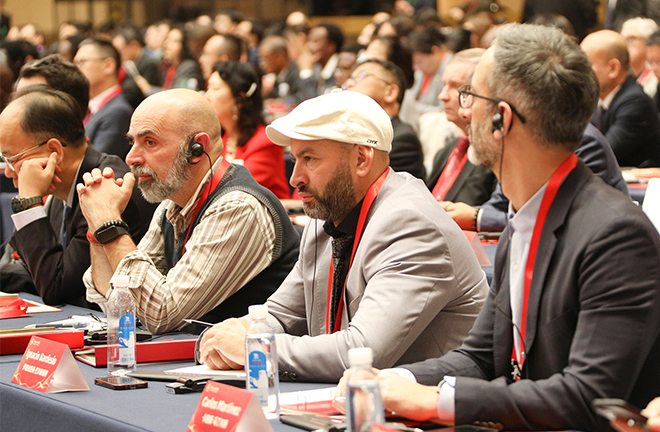
A scene at the forum Photo: Wang Zhou/CSST
Nearly 650 participants from more than 80 countries and regions gathered in Beijing on Nov. 21-22 for the International Forum on Overseas Studies of Xi Jinping Thought on Socialism with Chinese Characteristics for a New Era (2026). This year’s forum, hosted by the Chinese Academy of Social Sciences, took as its theme “The Great Way: Building a Community with a Shared Future for Humanity.” Drawing on their countries’ historical experiences and present-day concerns, participants discussed what building such a community entails, how civilizations can learn from one another, and what other countries might learn from China’s experience with modernization.
Philosophical roots of shared destiny
Why does the vision of a community with a shared future for humanity resonate across civilizations and regions? In the view of Teshome Toga, a former speaker of Ethiopia’s House of Peoples’ Representatives and former director general of the International Bamboo and Rattan Organization, the answer begins with the fact that all countries share one planet and the conditions that shape their security and development are now deeply interconnected. “No country, big or small, can stand on its own,” he told CSST.
Bert Hofman, a professor from the National University of Singapore and former World Bank country director for China, Mongolia, and Korea, argued that the vision already rests on an important practical foundation. Its essence, he suggested, can be expressed in a single word—“shared.”
“The UN-based system is, in a way, a shared community for mankind,” he said. “It does not work perfectly, and of course, the underlying power relationships have changed greatly.”
What the world most needs now, Hofman added, is shared prosperity, shared security, and shared ideas on governance. That need makes this a critical moment to rethink how such a community can be built.
Cássius Guimarães Chai, a professor from the Federal University of Maranhão and a prosecutor with the Public Ministry of Maranhão in Brazil, traced the vision to a shift already apparent in international relations. “The consequences of national decisions increasingly extend beyond the territories in which they are taken,” he explained. “A financial disturbance, an ecological disaster or a technological disruption can travel through relationships that no single state entirely controls.”
The international community, Chai said, remains politically diverse, yet the conditions that shape each country’s security and development are so closely intertwined that cooperation is essential. In his view, what makes the vision distinctive is that “it does not require countries to abandon their different social systems or civilizational traditions.”
“Cooperation is envisaged among countries with different histories, cultures and levels of development,” he added.
Chai drew a distinction between a community built on shared interests and one built on a shared future. “Interests may converge for a particular negotiation and diverge again when circumstances change. A shared future, by contrast, acknowledges lasting relationships of vulnerability and responsibility even when preferences do not coincide.”
“The concept therefore opens a discussion about the institutions through which coexistence can acquire practical meaning: prevention of conflicts, equitable development opportunities, access to knowledge, and cooperation in addressing collective risks,” he explained. “The strength of a community with a shared future lies in its invitation to think of coexistence as a continuing undertaking, rather than an occasional arrangement among governments.”
Mutual learning through intellectual resources
The pursuit of a shared destiny requires a sound intellectual foundation. For Toga, any discussion of Xi Jinping Thought on Socialism with Chinese Characteristics for a New Era must begin with each country’s specific realities. “Every country has its unique characteristics,” he told CSST. Each, he observed, is considering the nature of socialism in light of its own experience.
“China has its own civilization, history, aspirations as a nation, historical circumstances, and social and economic settings,” Toga said. “Instead of simply adopting socialism as it is, it is important to try to align it with your national characteristics.”
Hofman described Xi Jinping Thought on Socialism with Chinese Characteristics for a New Era as a rich resource that connects past and present, China and the wider world, and can inform public debate today. He came to the forum to revisit periods of profound social transformation and explore two questions. How did Chinese and Western intellectuals and philosophers understand and respond to such upheavals? And what roles should the state and other actors play in managing them?
“Whether it is Chinese thought, medieval Islamic thought, or Renaissance thought from the West, there is such a rich collection of thought that we can all use to deal with today’s problems, whether they are problems of income distribution, international inequality, climate change, or environmental pressure,” Hofman said.
Understanding through two-way exchange
During the conference, participants speaking different languages and coming from different academic backgrounds moved among the main forum, the parallel sessions, the youth forum and the high-level dialogues.
Asked what distinguished the forum and accounted for its appeal, Zheng Yongnian, dean of the School of Public Policy at The Chinese University of Hong Kong, Shenzhen, pointed to two features. The first was the breadth of participation. The forum brought together scholars from advanced economies, representatives of international organizations, and participants from many walks of life in countries at different stages of development. That mix, Zheng explained, gave participants scope both to explore theoretical questions in depth and to draw lessons from China’s experience.
The second feature, Zheng continued, was the dialogue among civilizations that the forum made possible. By sharing knowledge and examining China’s development from the perspectives of different civilizations, participants gave practical expression to the Global Civilization Initiative—one of four global initiatives, alongside the Global Development Initiative, the Global Security Initiative, and the Global Governance Initiative. Such exchanges, he said, benefit everyone involved by deepening mutual understanding and helping to build consensus.
For Zheng, the discussions also raised a more specific question. China has accumulated a wealth of experience and achieved notable results in the course of modernization. How might scholars distill that experience into a theory of broader relevance? Zheng stressed the importance of this theoretical work, which calls for scholars from different countries to bring their own perspectives to the study of Chinese modernization.
Asked about the contemporary value of Xi Jinping Thought on Socialism with Chinese Characteristics for a New Era, Chai told CSST that the vision of a community with a shared future for humanity sets out a broad understanding of what it means for countries to coexist and share responsibility. He linked that vision to the four global initiatives. “The Global Development Initiative places development and the UN 2030 Agenda for Sustainable Development within international cooperation; the Global Security Initiative emphasizes dialogue and common security and attention to the sources of instability; the Global Civilization Initiative articulates respect for civilizational diversity and mutual learning; and the Global Governance Initiative makes principles of sovereign equality, the international rule of law, multilateralism, a people-centered approach and action-oriented governance explicit within an institutional reform agenda.”
Chinese modernization and the experience it shares
As the discussion turned from the vision of a shared future to the paths countries take toward development, Chinese modernization came into focus. What struck him most about China’s experience, Hofman told CSST, was its continuity. “If you look back in history, the call for modernization started in the 19th century, in the late Qing Dynasty. It has now become the banner for the great rejuvenation of the Chinese nation.”
That continuity, Hofman stressed, is clearest in the ideas that have guided China’s modernization. While specific tasks and policy priorities have shifted from one stage to the next, the pursuit of national strength, national rejuvenation, and the people’s well-being has remained a constant. Those enduring aims, in his view, have given Chinese modernization a sense of direction even as China has continued to refine its approach.
Zheng said that Chinese modernization is closely linked to the Five-Sphere Integrated Plan—which calls to promote coordinated progress in the economic, political, cultural, social and eco-environmental fields—and shapes both China’s own development and its approach to international development cooperation. In recent years, Chinese modernization has drawn particular interest in discussions abroad. To explain why, Zheng traced the history of modernization itself.
Modernization first took hold in the West, Zheng explained, and as it spread elsewhere, it was widely equated with Westernization for much of its history. After World War II, many former colonies largely followed the Western path to modernization upon gaining independence. In Zheng’s view, few had succeeded by the time China rose to prominence. Even the success of a handful of small economies was difficult to replicate elsewhere, given their limited scale.
As China rose, observers began to recognize a different path to modernization. Countries of the Global South in particular have taken a keen interest in what China’s approach entails and how it has worked in practice. That is why China pays close attention to development elsewhere in the world even as it pursues its own modernization and sustainable development, Zheng said.
“Chinese modernization gives countries another option beyond the Western one as they explore their own paths, and it adds to the diversity of modernization paths,” Zheng said. “Economies that tried the Western path and did not succeed are all the more eager to understand how China has managed to.”
A social science theory drawn from China’s modernization experience would have even broader significance. Zheng argued that the Western path to modernization was once seen as the one all countries would inevitably follow. He described this model as “pulling up the ladder”—countries that industrialized early raised barriers to keep others from following the same route and thereby preserve their own advantage. They then presented their experience as a set of prescriptions embodied in the “Washington Consensus” and other frameworks, and pressed other countries to adopt them.
“China, by contrast, has taken an open and sharing approach,” Zheng said. “Having developed, China encourages and helps other countries to develop alongside it and works for shared prosperity in the international community. China’s development experience is open, and it is shared with other countries on the premise of respecting each country’s own choices.”
“China hopes that every country will find a modernization path suited to its own civilization, culture, and national conditions. Only such modernization can be sustainable, and only such modernization can succeed,” Zheng concluded.
Edited by YANG LANLAN