
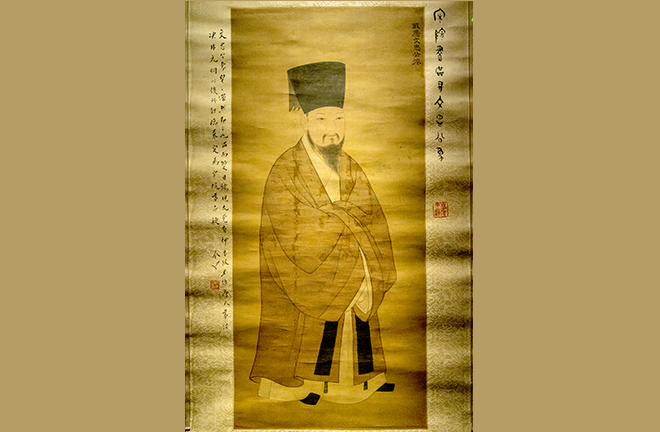
Portrait of Ouyang Xiu Photo: VCG
Ouyang Xiu, a leading literary figure in the mid-Northern Song Dynasty, was not a painter and left no systematic theory of painting. Nevertheless, Chinese literati traditionally cultivated an appreciation of the guqin (Chinese zither), board games, calligraphy, and painting, and ideas from literature and the visual arts often informed one another.
For Ouyang, painting embodied the spirit of the scholar-official class and offered both intellectual sustenance and a means of emotional expression. The world evoked by a painting extends beyond what meets the eye to reveal the artist’s inner state. In letters and notes, he often appraised the works of artists past and present, while some of his poems inscribed on paintings explored questions of artistic expression. His observations centered on the relationship between form and spirit, emphasizing the conveyance of meaning rather than the mere depiction of form.
Ouyang’s prominence in literary circles gave this principle considerable influence over artistic development during the Song Dynasty and in later periods. It laid a theoretical foundation for literati painting and encouraged later painters to pay greater attention to the intellectual substance of their works. Its influence extended to Chinese painting as a whole, guiding it beyond the mere imitation of outward appearances and toward the expression of inner feeling and the evocative ambience of nature.
Ouyang Xiu's View of Painting
Ouyang emphasized that painting and poetry follow the same principle: Both must convey boundless feelings through a limited range of images. Painting, he argues, should go beyond superficial resemblance to capture the inner spirit of its subject and express the painter’s personal sensibility. This view elevates painting from the simple reproduction of objects to a form of intellectual expression. It challenges the mechanical craftsmanship of professional painters of his time, who judged paintings solely by their fidelity to outward appearances, and champions the literati ideal of “few strokes, yet meaning fully expressed.”
The theory of form and spirit underlying Ouyang’s emphasis on meaning over outward likeness has its roots in Zhuangzi’s notion of grasping meaning while setting form aside. Moving beyond appearances to grasp the essence of things is central to the Daoist philosophy of Laozi and Zhuangzi. Applied to art, this approach encourages artists to look past surface appearances and apprehend that essence directly, giving artistic creation greater depth. Literati painters of the Song Dynasty were no longer satisfied with simply imitating reality or depicting its outward appearance—they sought to capture the essential nature of what they painted. The influence of Daoist philosophy on Chinese painting thus found expression in a shift from form toward spirit. In traditional painting, artists often focus on depicting specific objects or scenes, such as landscapes, flowers, and birds. As the theory of form and spirit took hold, however, literati painters began to give greater attention to the meaning conveyed by their works and to infuse them with their own feelings. Painting became more closely bound to subjective experience and the artist’s inner world. This integration of feeling and artistic practice encouraged literati painters to move beyond reproducing visible reality and give fuller expression to personal emotion.
Ouyang’s emphasis on meaning over outward likeness places the communication of subjective emotion and spirit through art at the heart of painting, rather than the faithful reproduction of visible shapes and appearances. A painting can thus transcend material form to attain a higher intellectual realm. Meaning begins with the artist’s aspirations and feelings, reflecting both personal character and emotional experience. Drawing on these experiences and perceptions, the painter imbues the image with emotion to create a distinctive artistic expression. Meaning also encompasses an understanding of nature, society, and the humanistic spirit. Through observation and reflection, artists distill the essence of things and incorporate it into their work. Conveying meaning ultimately involves bringing form and spirit together. The painter depicts appearances while also using them to communicate emotion. This fusion gives a work both visual beauty and intellectual force.
Giving precedence to meaning over likeness does not entail following a rigid sequence of theoretical stages. It is a gradual process through which feeling, understanding, and form become integrated. Subjective feeling provides the starting point, rooted in the artist’s emotional life and character. As experience accumulates and understanding deepens, the artist gradually develops insight into the external world, ultimately bringing form and emotion into harmony through artistic creation. Capturing the spirit and resonance of a subject means giving full expression to its natural vitality and evocative atmosphere, rather than merely imitating its visible shape and appearance. By depicting the forms of things, the painter conveys a spirit that transcends their concrete appearance and expresses insights into nature, human culture, or the life of the cosmos. The flower-and-bird paintings of Xu Wei, exemplify this approach. His vigorous, free-flowing ink brings the vitality and atmosphere of his subjects into heightened artistic expression. Such attention to a subject’s spirit and resonance is central to Ouyang’s principle, allowing a work to transcend literal representation and become a vessel for spirit and emotion. In Xu’s work, the vitality of nature merges with subjective feeling. This pursuit of art’s essential qualities encourages artists to look beyond material form toward inner spirit and emotion, allowing painting to express rich and profound subjective feelings.
Ouyang’s theory of form and spirit does not, however, reject the depiction of form. Form remains the means through which the artist conveys meaning, expressing subjective emotion and personal reflection. The later writer Su Shi stressed that “only when form and spirit are both fully realized is true excellence achieved.” Careful treatment of the subject, composition, and ink gives a painting visual beauty and immediacy. Choices of color and brushwork, meanwhile, imbue these forms with subjective emotion, taking the work beyond simple likeness toward greater depth of expression. Representation retains its value: Used judiciously, it preserves the painting’s visual appeal while giving emotion tangible expression. Abandoning it altogether risks sacrificing the visual clarity that holds the viewer’s attention and gives the work artistic force. Ouyang’s emphasis on meaning over likeness thus finds fulfillment in the union of form and spirit. Together, they draw viewers into the world of the painting and allow them to experience the feelings it conveys. By encouraging artists to attend both to the depiction of form and to the expression of emotion, this principle contributes to the development of painting as an art.
The Aesthetic of Meaning over Likeness
Ouyang’s emphasis on meaning over likeness profoundly influenced both the theory and practice of literati painting. Ni Zan was an early exponent of this approach, advocating “sketching freely and loosely, without seeking exact likeness.” His spare, broadly rendered depictions conveyed emotion through poetic suggestion rather than exact reproduction, allowing viewers to sense the feelings that informed his work. This practice expanded the expressive possibilities of literati painting. In the Ming Dynasty, Dong Qichang introduced the concept of shiqi—the spirit and bearing of the scholar—in his theory of the Northern and Southern Schools. He valued the painter’s intellectual character and creative enthusiasm, arguing that painting should express the artist’s inner state and feelings. Thereafter, Chinese literati painters placed greater emphasis on cultivating and conveying this distinctive scholarly spirit, deepening the artistic substance of literati painting and pursuing the cultivation of personal character alongside the refinement of their art.
By giving precedence to meaning over outward likeness, Ouyang’s theory of form and spirit helped transform the Chinese understanding of art’s very nature. Painting acquired a purpose beyond technical accomplishment, becoming a means of intellectual expression. This reorientation shaped the distinctive character of Chinese painting and shifted the emphasis of literati painting from depicting external reality to expressing the artist’s inner world. It marked an important turning point in the history of Chinese literati painting and a significant shift in the philosophical understanding of art’s fundamental nature.
Liu Jufang is a professor from the School of Humanities at Jinggangshan University.
Edited by ZHAO YUAN