
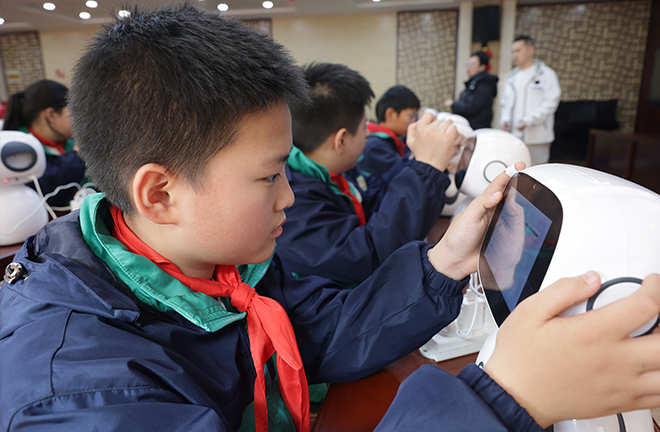
Students take a mental health assessment with an AI robot at Xiying Road Primary School in Xi’an, Shaanxi province, March 11. The robot analyses their micro-expressions as they answer. Photo: VCG
Generative AI is rapidly becoming part of education, bringing new tools to school-based mental health services. From intelligent facial-expression recognition and psychological risk screening to conversational psychological support and AI-delivered mental health lessons, a growing array of products is extending the reach of these services. The Guidelines for the Use of Generative Artificial Intelligence in Primary and Secondary Schools (2025 Edition) list limited psychological adjustment support as one of its application scenarios, with students required to use generative AI under the guidance and supervision of teachers and parents. AI’s role in school mental health services has thus moved beyond a technical possibility to a practical concern, requiring clear principles for its use, defined responsibilities, and appropriate governance.
Introducing the technology is not in itself problematic. The concern is that the growing emphasis on efficiency, coverage, and immediate responses could reduce mental health services to recognizing patterns in data and generating language. Can schools, amid these changes, sustain a genuine understanding of students, offer continuing support, and take responsibility for their care? AI may change the way mental health services are delivered, but it must not change their underlying purpose and foundation—supporting human growth through real relationships.
Supportive relationships as foundation
Psychological risk among primary and secondary school students often develops out of sight, accumulates over time, and is shaped by their circumstances. Some students in crisis may have no clear psychiatric diagnosis and show no obvious abnormalities in their daily behavior. Yet insufficient family support, distant peer relationships, strained interactions with teachers, and persistent academic pressure can gradually erode their sense of connection, self-worth, and hope for the future. Ordinary distress often develops into a psychological crisis through this accumulation of pressure and loss of support, without anyone intervening in time, rather than through the effects of a single symptom.
School-based mental health services must therefore do more than detect problems once risk indicators rise. Supportive relationships need to be built into everyday school life, giving students opportunities to express distress, feel understood, and receive help as pressures begin to mount. What protects students is not simply the presence of a particular tool at school, but access, when difficulties arise, to peers who are willing to listen, teachers they can trust, and professionals able to provide sustained assistance. Mental health services belong within the relationships through which schools educate and support their students, rather than operating as a separate technical service.
Defining limits of AI-assisted mental health services
As AI becomes more accessible, adolescents are beginning to turn to it for psychological support in their everyday lives. A nationally representative US survey published in JAMA Pediatrics in 2026 found that 19.2% of adolescents and young adults aged 12 to 21 had used AI chatbots for mental health advice, and 63.3% of these users had never told anyone else. AI may make it easier to express distress, but it can also keep that distress confined to private exchanges, leaving parents, teachers, and professionals unaware that help is needed.
AI offers advantages in sharing mental health knowledge, providing initial emotional support, and flagging signs of risk. Systematic reviews and meta-analyses focusing on adolescents and young adults indicate that conversational AI agents have some potential to alleviate depressive symptoms, although their effectiveness in addressing anxiety and other mental health problems has yet to be established. A randomized controlled trial published in NEJM AI in 2025 also found that generative AI tools developed with professional training and safety safeguards could ease some symptoms of depression, anxiety, and eating disorders among adults in clinical settings. High-quality research on such interventions for minors remains limited, however, and general-purpose chatbots should not be equated with validated tools for psychological intervention.
AI can generate empathetic language, but language alone does not create an empathetic relationship in the human sense. A study published in the Proceedings of the National Academy of Sciences in 2024 found that, when participants did not know who had produced the responses, those generated by AI made them feel better understood and heard than those written by humans. Learning that the responses came from AI, however, had a negative effect that canceled out this linguistic advantage. This is because empathy involves more than accurately recognizing emotions and finding the right words. It requires a willingness to give time and attention, understand someone’s particular circumstances, and take responsibility for what follows. Genuine empathy emerges when someone pauses, sets aside other tasks, and makes time to listen. This personal engagement is central to the relationship and difficult for algorithms to replace.
More concerning still is AI’s tendency toward sycophancy—telling users what they want to hear. A study published in Science in 2026 examined 11 mainstream AI models and found a widespread tendency to offer excessive affirmation and agree with users when giving advice. Even when users described behavior involving deception, manipulation, or harm to others, the models might still endorse their position. Two preregistered experiments further found that, after interacting with sycophantic AI, users became more convinced that they were right and less willing to reflect on their own behavior, understand others’ perspectives, or repair relationships—while placing greater trust in the model and becoming more dependent on it. For individuals with paranoid ideation, such persistent affirmation may reinforce their cognitive biases and even intensify psychotic experiences such as delusions.
Students also differ in where they are willing to turn for help. A six-month longitudinal survey of 1,848 primary and secondary school students conducted by the authors’ research team found varying combinations of willingness to seek counseling from a person and psychological support from AI. Paradoxically, students experiencing more severe psychological crises were more likely to be unwilling to seek either form of help, whereas students with stronger social-emotional skills were more willing to use a range of support resources, including AI. These findings suggest that AI can offer a first point of contact for students who fear stigma, have difficulty expressing themselves, or are not yet ready to seek face-to-face help. Yet providing a technological route to support does not automatically remove barriers to help-seeking, nor does it ensure that services reach students at greater risk who are reluctant to ask for help. AI can expand what school-based mental health services can offer, but it must operate within a system of identification, referral, and sustained support under professional responsibility.
Building technology-enabled interpersonal support network
When introducing AI into school-based mental health services, the priority is to help students connect with more people they can trust and improve the accessibility, continuity, and professionalism of real-world support networks, rather than simply adding devices or launching features. This calls for action at three levels—peers, teachers, and institutions—with technology supporting the human network throughout.
When adolescents face difficulties, they often turn first to their peers. Sports, arts, labor, and club activities can give students regular, sustained opportunities to interact and cooperate without the pressure of pursuing specific outcomes. Schools should also provide appropriate guidance on peer support, helping students learn to listen, recognize risk, and seek help from adults promptly. Peer support does not ask students to become psychological counselors. Its purpose is to reduce isolation, help distress come to light earlier, and make it easier to ask for help.
Responsibility for students’ mental health cannot rest with a handful of full-time school psychologists. It needs to be woven into classroom management, subject teaching, and daily interaction. Head teachers, subject teachers, and those who work regularly with students through sports, arts, labor, and club activities can all become trusted figures in their lives. Teachers do not all need to become counselors, but they do need basic listening skills, an awareness of warning signs, and the ability to refer students for further help. Students should know that, when difficulties arise, at least one adult they can turn to in person will take the time to understand their situation and connect them with ongoing support.
AI can be used for appointment scheduling, record-keeping, referral, and basic screening, but these functions should serve the network rather than replace it. AI-assisted coordination between schools and outside services can connect early identification with personal support, referral, and continuing care, strengthening the network as a whole. Some schools experimenting with smart listening kiosks, for example, explicitly use AI as an aid, while teams of human listeners provide emotional support directly to students. AI performs three main functions: organizing information and highlighting key points to support structured assessments and standardized records, documenting service delivery and monitoring quality to inform professional supervision, and tracking changes in students’ psychological resources to recommend follow-up action and flag potential risks. In this arrangement, AI supports workflows and data analysis, while people remain responsible for deep empathy, value judgments, and action in the real world. Technology improves the process, and people sustain the relationships, creating a more dependable balance between efficiency and human warmth.
AI is reshaping the tools available to school mental health services, but it should not weaken the human relationships at the heart of education. Improvements cannot be measured simply by counting the risks identified or conversations handled. They also depend on whether students reach trusted people sooner, receive more consistent support, and know who is responsible for their care. Schools need a support system with clear boundaries, effective coordination, and people who take responsibility, rather than a seemingly all-powerful “AI psychology teacher.” Keeping technology in a supporting role, with people responsible for understanding students, exercising judgment, and acting on their needs, allows school mental health services to become more efficient while retaining their human warmth and sense of purpose amid technological change.
Ma Lijun is a professor from and dean of the School of Public Health and Management at Guangzhou University of Chinese Medicine. Guo Yongxing is an associate research fellow from the Center for Studies of Psychological Application at South China Normal University.
Edited by YANG XUE