
Rural women find new agency through traditional crafts
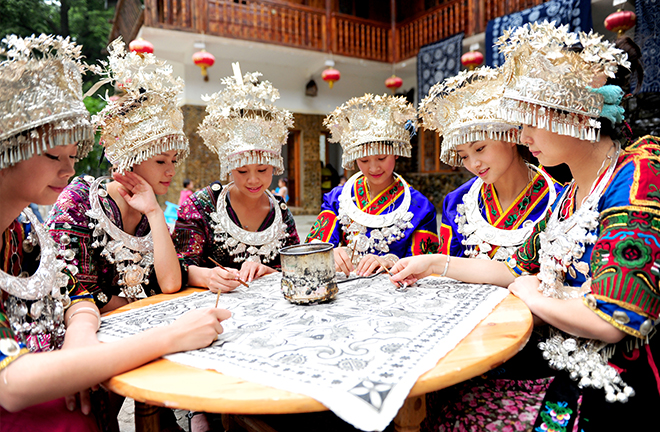
The article “The Power at Their Fingertips: Ethnic Handicrafts and the Remaking of Rural Women’s Selves” presents vivid examples from Dong and Miao ethnic villages in Guizhou Province, including the “Cloud Granary” entrepreneurial team, embroidery workshops, and batik cooperatives. These cases show how ethnic handicrafts have become sources of income amid China’s drive for advancing rural revitalization across the board, helping rural women reshape their identities.
The revival of traditional crafts has not only increased household incomes but also opened the way for local women to become entrepreneurs, interpreters of their own cultures, and participants in rural public affairs. Beyond its implications for safeguarding intangible cultural heritage and developing local industries, this revival also prompts a reassessment of the value of labor, social relations, and the gender order. The growth of women’s agency thus involves more than personal development—it is closely bound up with cultural capital, social relationships, and gender structures.
From local skills to social recognition
Sociologists commonly distinguish among economic, cultural, and social capital, recognizing that one form can be converted into another. These concepts offer a useful framework for understanding the revival of ethnic handicrafts. Embroidery, batik, and Dong folk singing—traditional practices woven into everyday life in Guizhou—embody knowledge and skills that local women have accumulated over time. Yet neither the market nor society necessarily recognizes their full value. Translating these skills into income and symbolic capital requires institutional support and access to opportunities through intangible cultural heritage protection programs, cultural tourism, commercial orders, and international exhibitions. Such a transformation cannot occur in isolation.
Women in Liufang village secure orders through embroidery workshops, and their products can be displayed at the China (Shenzhen) International Cultural Industries Fair. Batik artisans in Jijia village expand their markets through cooperatives and international exhibitions. These examples show that women’s skills have not suddenly become valuable—rather, new social standards have redefined how that value is recognized. The women gradually come to be seen as skilled producers rather than ordinary workers. Recognition from outside their communities also changes how they see themselves and their own worth. They have begun to recount village histories, interpret traditional patterns, and help pass on their cultures. Their growing sense of agency is therefore more than a psychological development occurring in isolation: It takes shape as their work and abilities gain recognition.
The conversion of capital, however, is neither automatic nor effortless. How training opportunities, market access, and organizational resources are distributed shapes women’s opportunities to earn income and gain recognition. Researchers examining these initiatives could therefore look beyond successful participants’ confidence and personal growth to ask deeper questions: Who can enter the market? Who controls access to buyers? And are new disparities in resources emerging among women?
Social ties in economic life
The batik cooperative in Jijia village illustrates how economic activity is embedded in social relationships and institutional structures. Typically, when a workshop cannot fulfill an order, it may subcontract the work to another workshop for a fee. In Jijia village, however, cooperation between workshops is shaped not only by price and efficiency but also by kinship ties, local reputation, and norms of reciprocity. The growth of the ethnic handicrafts industry therefore need not erode traditional social relationships under market pressures. Existing social networks can instead facilitate cooperation, reduce costs, and help scattered household workshops cope with large orders. Local culture and social relationships thus become important resources for industrial development.
Marketization also creates new tensions. As outside enterprises, tourist spending, and commercial orders increasingly drive embroidery and batik production, consumer preferences and commercial imperatives exert greater influence over both the designs and the cultural meanings these crafts convey. The rich diversity of local cultures may be reduced to a set of readily recognizable, marketable ethnic symbols.
These experiences suggest that turning culture into a commodity does not necessarily lead to either the decline of tradition or cultural renewal. Assessing the benefits and drawbacks requires examining how much say local women have in product design, the transmission of skills, and cultural expression, and whether the income generated is fairly distributed. For the handicrafts industry to strengthen local communities’ autonomy, women must be able both to participate in cultural production and to help define cultural value.
Strengthening women’s agency
Turning home-based handicraft production into a profession allows women to combine caregiving with income-generating work, thereby improving their standing within the household. Yet earning an income does not in itself bring gender equality. The economy and society depend on the considerable work involved in sustaining households and raising and caring for successive generations of workers. Women perform much of this labor, but its economic value often goes unrecognized. The rural women involved in these initiatives thus work at the intersection of paid production and family care.
“Starting a business from home” therefore brings women into the economic sphere, but it may also add to their workload without altering the traditional division of labor. In Liufang village, some men have begun contributing to village design and guesthouse planning—a welcome sign that the traditional division between men’s work outside the home and women’s responsibilities within it is beginning to shift. Assessing whether gender relations have improved substantially, however, requires a closer look: Is caregiving shared more equitably? Can women independently control their earnings? And do they exercise genuine decision-making power in their families and cooperatives?
Gains in women’s agency therefore cannot be measured by income or self-confidence alone. Changes in working hours, power within the household, and the distribution of resources must also be considered. Otherwise, even as their economic circumstances improve, women may remain constrained by an unequal share of caregiving responsibilities. These entrepreneurial initiatives also depend on coordinated support from government, organizations, and markets. Women’s success reflects not just their own diligence or confidence but also the combined contribution of public resources, social support, and institutional arrangements. Putting advancing rural revitalization across the board into practice therefore requires both strengthening women’s entrepreneurial capabilities and ensuring reliable market support, labor protections, and public services.
Chen Zhao is an associate professor from the School of Ethnology and History at Guizhou Minzu University.
Edited by ZHAO YUAN