
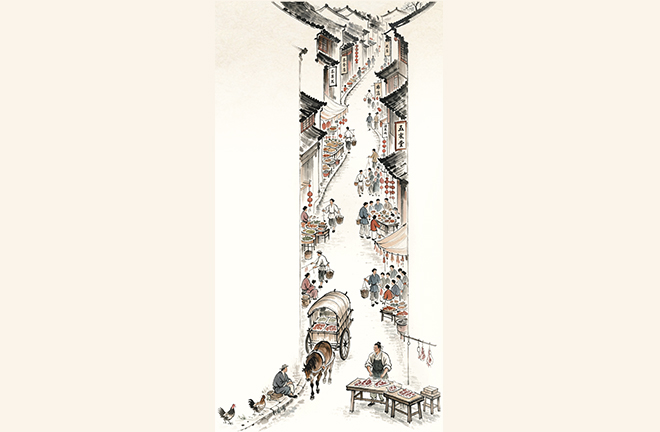
Image generated by AI
In the gallery of characters in classical Chinese fiction, the butcher is a figure of striking contradictions. Wielding sharp blades and confronting life and death directly, butchers embody the earthy vitality of the marketplace while testing the limits of ethical conduct. They carry within them both the coarse vitality of folk society and the complex folds of human nature and power within the traditional social order.
From the tiger-like ferocity of Zhang Fei in Romance of the Three Kingdoms and the tyranny of Zhen Guanxi in Water Margin to the snobbery of Hu the Butcher in The Scholars and the alertness of the nameless butcher in Qing-dynasty novelist Pu Songling’s tales, their significance extends well beyond their trade. Through them, novelists explore the ways of the world and stir the human heart.
These humble figures, situated at the bottom of society yet seemingly holding “power over life and death,” bring both the warmth of everyday experience and a blade’s sharp edge to the dissection of traditional society—its moral codes, stratification, and spiritual life. Their stories offer a distinctive perspective on the spirit of ordinary people that animates classical Chinese literature.
Dual symbol of power and order
The butcher’s blade is above all a dual symbol of power and order. In agrarian society, the ox was the mainstay of farming, and slaughtering it carried a suggestion of untamed force straining against the bounds of convention. In Romance of the Three Kingdoms, Zhang Fei begins as a butcher in Zhuo Commandery (present-day Zhuozhou, Hebei Province). He stands “eight chi (about 1.85 meters) in height, with leopard-like eyes and a round head, a swallow’s jaw and tiger’s whiskers,” as well as a voice like thunder and the force of a galloping horse. His trade gives him extraordinary courage and physical strength.
After the Peach Garden Oath, he carries that strength onto the battlefield, wielding his serpent lance. At Dangyang Bridge, his thunderous shouts send the enemy fleeing—the raw vitality honed at the butcher’s block finds its heroic expression. By linking the butcher’s identity to heroic mettle, the novelist implicitly acknowledges the power of ordinary people: True valor owes less to aristocratic status than to the candor and fierceness of those who face life and death directly.
Zhang Fei’s roots in the butcher’s trade give chivalry and courage a distinctly plebeian character. Forthright and untouched by political guile, he remains steadfast in brotherly loyalty and holds to his moral principles despite his rough manners and impetuous temper. His character stands in sharp contrast to the scheming and calculation of the court.
Where Zhang Fei embodies heroic possibility, Zheng Tu (Zhen Guanxi) in Water Margin and Hu the Butcher in The Scholars reveal the secular and alienated dimensions of the butcher figure, reflecting the maladies of the society around them. Zheng Tu, a butcher who terrorizes the people of Weizhou in modern-day Gansu Province, styles himself “Zhen Guanxi” (The Guardian of the Western Pass). He turns the ferocity of his trade against the innocent, using his strength and intimidating presence to ride roughshod over the marketplace. The three punches with which Lu Da kills him deliver a chivalrous punishment for wrongdoing, but also settle accounts with “violence from below.”
Zheng Tu’s downfall stems from mistaking the force he commands in his trade for authority over others. The blade that earns his living becomes an instrument of oppression, placing him squarely against justice. Through him, the novelist suggests that violence is neither good nor evil in itself—its moral character depends on the conscience of the person who wields it and the limits that person is prepared to respect.
Hu the Butcher embodies the snobbery bred by feudal ethics and the keju (imperial examination) culture. As Fan Jin’s father-in-law, he curses and belittles him at every turn before Fan’s success in the provincial examination, calling him a “disgrace” and a “rotten, useless man.” Once Fan Jin passes, Hu immediately changes his tune, bowing and scraping, fawning incessantly—his contempt transformed into abject deference.
Honed by worldly calculation, Hu’s knife becomes a tool for measuring status and currying favor. His snobbery is more than a personal failing: It is a microcosm of a society that “values only official rank and fame.” With a satirist’s biting touch, the novelist sets Hu’s former arrogance against his newfound servility, laying bare the distortions of human nature and the chill of everyday dealings in a society governed by the imperial examination system.
Embodying wisdom and humanity
Beyond ferocity and snobbery, the butchers of classical fiction reveal the practical wisdom of ordinary people and quieter glimmers of humanity. In Pu Songling’s “The Wolf,” a nameless butcher, threatened by two wolves, first throws them bones, then takes shelter against a woodpile, and finally kills them with his blade. His composure and quick thinking reveal the resourcefulness of a humble man in desperate straits. Neither grandly heroic nor morally debased, he struggles simply to stay alive. The tale returns the butcher to the essentials of his existence: making a living by the knife, protecting himself with his wits, and asserting the basic right to survive in a world where the strong prey on the weak.
Most of these butchers come from the lower ranks of society, untouched by the cultivation offered by poetry, books, rites, and music, yet their grasp of life is immediate and sure. They wield knives and take life, and may seem cold-blooded, yet they often understand the warmth of human existence better than literati and gentlemen.
Counted among the “hundred crafts” in the traditional social hierarchy, butchers held little prestige. Their trade nevertheless placed them at the meeting point of life and death, while their dealings linked the marketplace to the wandering world of outlaws and adventurers, giving novelists a revealing vantage point on society. To write about butchers is thus to write about ordinary people—their strength, their worldly desires, their ingenuity in surviving, and the human nature laid bare by power, self-interest, and desperate circumstances.
Between ‘wildness’ and ‘ethics’
As a cultural figure, the butcher in classical Chinese fiction inhabits the tension between “wildness” and “ethics.” The butcher’s knife can disrupt order or uphold justice, just as its wielder can be captive to worldly self-interest or guided by the moral codes of ordinary people.
Zhang Fei turns the strength of his trade into the courage of a loyal and righteous hero, while the tyrannical Zhen Guanxi faces a violent reckoning at a chivalrous hero’s hands. Hu the Butcher’s snobbery exposes the fickleness of social regard, while the butcher in Pu Songling’s tale survives by his quick wits. For all their differences, these figures serve a common literary purpose: Their small lives illuminate the larger world, revealing the social fabric of traditional China and the workings of the human heart.
The butcher’s distinctive literary value lies in unsettling the neat divisions between “gentleman” and “petty man,” the “refined” and the “vulgar.” These figures are imperfect—rough, snobbish, selfish—yet vividly human. Low in status but possessed of a power of their own, they may emerge as heroes or villains, or, more often, simply as people struggling to survive. Such complexity is precisely the charm of classical fiction. Neither idealized nor condemned outright, these characters come to life through plain, honest strokes that capture human nature in its contradictions and society in all its texture.
Across classical Chinese fiction, the butcher often stands outside the narrative spotlight, yet occupies a distinctive and essential place. The knife becomes a medium, its wielder a mirror, reflecting the vitality of ordinary people, the myriad faces of everyday life, and the endurance and fractures of traditional ethics.
These humble, blade-bearing figures, with their human warmth and unvarnished temperaments, live within the pages of fiction, revealing truths about society and the human heart that belong as much to the marketplace as to the world of learned and elegant texts. The true power of literature lies not in ornate rhetoric, but in penetrating insight into authentic human nature.
Blades rise and fall, life gives way to death, and the stories of butchers carry forward an age-old Chinese exploration of survival, morality, and the human heart.
Chen Cailin is a professor from the College of Literature and Media at Yulin Normal University.
Edited by CHEN MIRONG