
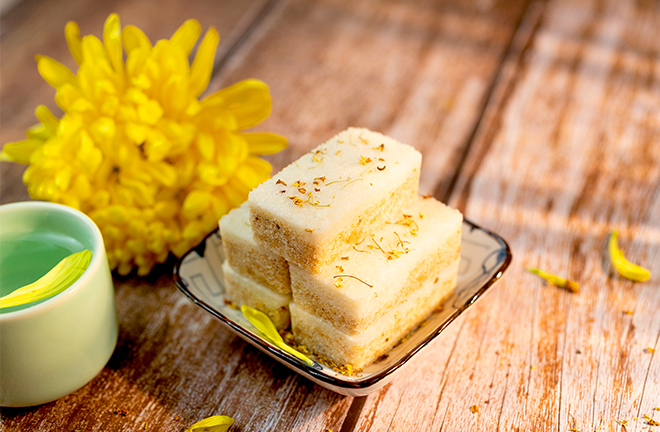
Drinking chrysanthemum wine and eating Chongyang cakes are major customs of the Chongyang Festival. Photo: VCG
In 845, Du Mu, then prefect of Chizhou (in present-day Anhui Province), celebrated the Chongyang Festival by climbing Mount Qi with the visiting poet Zhang Hu and a supply of wine. The outing inspired “Climbing Mount Qi on the Ninth Day”: “In this world one rarely meets with an open-mouthed laugh; / chrysanthemums must be tucked all round the head before we go home. / Let us but get dead drunk to do honor to the festival; / no need to stand on the height and grieve over the setting sun.”
Du Mu was 43 by Chinese reckoning that year, and his official career had not gone smoothly. From a mountaintop, with the view stretching into the distance and the sun sinking in the west, thoughts turn readily to the passing years. His counsel was as much for himself as for his guest: An open laugh is rare enough—so tuck chrysanthemums all round your head, drink your fill and then go home; there is no need to sigh at the setting sun.
Today the Chongyang Festival is officially Seniors’ Day, and most people regard it as a festival exclusively for older people, with respect for the elderly as its core theme. Yet a look back at its origins reveals that, although age is written into the festival, the questions the ancients asked were chiefly about their own lives—how to prolong life, how to bid autumn farewell, how to greet their own advancing years with composure. Chongyang has evolved from reflection on one’s own life to concern for the lives of others—a change in expression, though its underlying spirit endures.
Chongyang: A name with longevity
In traditional Chinese thought, nine is a “yang” number. With nine marking both the day and the lunar month, the festival is called Chongyang, or “double yang,” and Chongjiu, or “double ninth.” Yet this festival bearing the name of yang arrives just as vegetation withers and yang energy wanes. For the ancients, the chill of the season could readily evoke the chill of old age—an association rooted in both nature’s rhythms and this way of reckoning time.
The ancients’ Chongyang customs centered on warding off disaster and prolonging life. Wu Jun’s Sequel to Records of the Strange (Xu Qi Xie Ji), written during the Southern Liang Dynasty (502–557), recounts how Fei Changfang warned his disciple Huan Jing that disaster would strike his household on the ninth day of the ninth month. To escape it, each family member was to tie a crimson pouch of zhuyu, or cornelian cherry, to their arm, climb to high ground, and drink chrysanthemum wine. Huan Jing took the whole family up the mountain. On returning at dusk, they found that their chickens, dogs, cattle, and sheep had all dropped dead, bearing the calamity in the family’s place. According to Wu Jun, this was the origin of the ninth-day customs of climbing high and drinking wine, and of women wearing zhuyu pouches.
The Miscellaneous Records of the Western Capital (Xijing Za Ji) records an old custom of the Han palace: “On the ninth day of the ninth month, wear zhuyu, eat peng cakes, and drink chrysanthemum wine—this makes people long-lived.” Zhuyu, with its sharp, pungent smell, was used to ward off evil. The chrysanthemum blooms after other plants have withered. Climbing high, wearing zhuyu, and drinking chrysanthemum wine—all three customs expressed the same wish for safety and long life.
Sorrows for autumn
From the Wei and Jin periods (220–420) onward, growing old became a recurring theme in Chongyang poetry—and the aging that occupied the poets was usually their own. Tao Yuanming opens “A Leisured Life on the Double Ninth” with: “Man’s life is short and full of cares and strife, / Yet man still longs to live a long, long life. / The Double Ninth arrives in its due time, / A festive name that is praised as sublime.” Elsewhere in the poem he writes: “The wine relieves me of many a care; / Chrysanthemums give me years to spare.” On the Double Ninth in 758, Du Fu feasted at the Cui family villa in Lantian (in present-day Xi’an, Shaanxi Province) and wrote “The Ninth Day at the Cui Family Villa in Lantian,” opening with the line “Old, I grieve for autumn but force myself to cheer.” He was 47 that year, and already called himself “old.”
When these poets wrote of decline, they wrote of what they felt in their own bodies, with Chongyang giving them the occasion to speak of it. Sorrow for autumn had been a standing sentiment among men of letters since Song Yu, a poet of the state of Chu during the Warring States Period (475–221 BCE). Through established Chongyang customs—climbing high and gathering for feasts—private melancholy found both expression and release. Du Fu’s line “Old, I grieve for autumn but force myself to cheer” turns on the word “force”: Cheer had to be worked for, and the Chongyang banquet offered a way to summon it.
Chongyang was also an occasion for the whole household to celebrate together, old and young. Huan Jing climbed the mountain with his entire family. For households with no mountain to climb, steaming Chongyang cakes to share with the family offered a symbolic substitute: Gao, “cake,” sounds the same as gao, “height.” In Beijing during the Ming Dynasty (1368–1644), a married daughter’s natal family would call her home to eat flower cakes for Chongyang, giving the day another name—the “Daughters’ Festival.” The festival brought old and young together to climb, eat cakes, and enjoy each other’s company—customs shared across generations.
Late-blooming chrysanthemums, enduring fragrance
In 1989, the ninth day of the ninth lunar month was designated the “Day for the Elderly” in China. The Law on Protection of the Rights and Interests of the Elderly, revised in 2012, provides: “The ninth day of the ninth lunar month each year shall be Seniors’ Day.” This has been a comparatively successful example of adapting a traditional festival to modern life. With respect for the elderly as its theme and its lunar date enshrined in law, the festival still falls in late autumn, when chrysanthemums bloom, allowing the old customs of climbing high and admiring the flowers to continue. Chongyang’s longstanding association with wishes for longevity also sits naturally alongside respect for the elderly, making the transition a fitting one.
The festival’s center of gravity has shifted accordingly. For the ancients, observing Chongyang meant thinking chiefly about facing their own decline. Today, Seniors’ Day directs attention toward how society should treat older people. This shift has strengthened the festival’s ethical significance, while leaving less room for reflection on one’s own aging. Modern festivals are often assigned to particular groups: Children’s Day belongs to children, the Qixi Festival is called “Chinese Valentine’s Day,” and the Double Ninth has become “Seniors’ Day.” A familiar scene follows: Older people receive visits and expressions of concern, seldom taking the lead in organizing celebrations themselves. Young people turn up with gifts, as though aging had nothing to do with the elderly.
A place at the table
According to the Communiqué of the 1% National Population Sample Survey in 2025, China’s population aged 60 and over has reached 321.22 million, accounting for 22.86% of the total. Average life expectancy has also risen to nearly 80 years. Du Fu wrote that “since ancient times, few men have lived to seventy”—today, reaching 70 is commonplace. For most people, old age spans several decades, many of them spent in good health, pursuing wide-ranging interests. For these “younger old” adults, opportunities to participate in social life are often a greater need than care.
Traditional respect for the elderly rested on two foundations. The first was reciprocity between generations within the family, which renowned Chinese sociologist Fei Xiaotong called the “feedback model”: Parents raise their children, while children support their parents in old age. The second was the experience accumulated by older people—as the saying goes, “Ignore the old man’s words, and loss is right before your eyes.”
Today, households are smaller and people are more mobile. Many parents and children live far apart, stretching the ties of intergenerational support. Technology changes rapidly, and it is often the children who teach their parents to use a mobile phone—what sociologists call “cultural feedback.” As both foundations weaken, upholding respect for the elderly becomes a responsibility shared across society, extending beyond the family and grounded in respect for every stage of life. Seniors’ Day gives this commitment an official place on the public calendar.
An annual festival cannot replace everyday companionship and institutional protection. Its chief purpose is to serve as a reminder. In recent years, many older people have taken the initiative to gather for climbs, poetry readings, and chrysanthemum viewing, keeping alive the old Chongyang pleasures of climbing high and composing verse. When young people join their elders on a mountain climb and witness their zest for life, their own later years become a little more inviting. A climb shared by old and young is closer to the original spirit of Chongyang than a visit simply to offer comfort.
Yi Na (Yeshi Lhamo) is a research fellow from the Institute of Ethnic Literature at the Chinese Academy of Social Sciences.
Edited by CHEN MIRONG