
Daoism, Legalism, or the Daoist Religion? —What is Laozi actually saying?
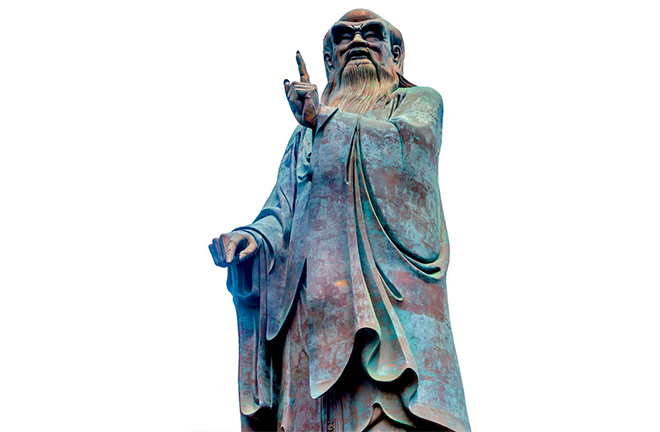
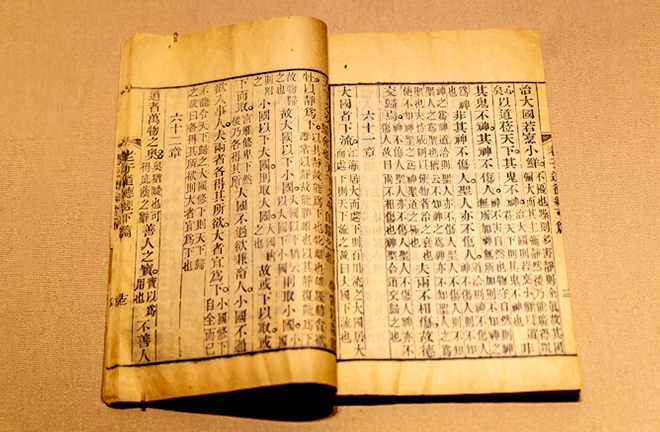
The Laozi in the collection of the National Museum of China Photo: VCG
Since the pre-Qin period (prior to 221 BCE), the Laozi—also known as the Dao De Jing—has been regarded as a classic and interpreted anew by successive generations.
Three main interpretive traditions emerged: the political, represented by the “Jie Lao” and “Yu Lao” chapters of the Han Feizi, which address practical questions of governance; the religious, represented by the Laozi Xiang’er Zhu (Xiang’er Commentary on the Laozi); and the philosophical, represented by third-century commentator Wang Bi’s Laozi Zhu (Commentary on the Laozi). The study of the Laozi gradually grew richer as these different traditions of interpretation took shape.
Supporting centralized monarchical power
Renowned Legalist thinker of the Warring States Period (475-221 BCE) Han Feizi, also known as Han Fei, was a major figure in the history of commentary on the Laozi, systematically interpreting the text and recasting its ideas as a theoretical foundation for monarchical rule. His “Jie Lao” develops a conceptual framework, while “Yu Lao” draws on historical allusions to substantiate Legalist theory. Together, the two chapters articulate a body of Huang-Lao political thought that supports centralized monarchical power.
Han Fei understood Dao (the Way) as an objective principle governing all things and guiding human affairs, translating it into the practice of monarchical rule through fa (law and methods), shu (management techniques), and shi (power or positional advantage).
The Laozi states that “instruments for the profit of a state should not be shown to the people”—a highly symbolic passage that Han Fei read as a reference to the ruler’s control over rewards and punishments. A monarch who relinquishes that control to his ministers puts his own rule at risk. The text’s natural metaphors thus became cautions about the exercise of sovereign power.
Such a reading does more than recover the text’s original meaning—it presses the text into the service of a distinctly Legalist agenda. Han Fei drew selectively on passages suited to practical politics, downplaying or reshaping the text’s emphasis on transcending power, embracing softness, and avoiding contention.
Yet his interpretation retains its significance in intellectual history. In his hands, the Laozi became an important resource for the Legalist art of rulership—an example of how interpretations of the classics respond to real-world problems.
Between being and non-being, root and branch
Wang Bi’s philosophical interpretation in the Laozi Zhu offers another important way to read the Laozi. Here, the text is no longer primarily a manual of monarchical statecraft—it becomes a philosophical classic concerned with the structure of the cosmos and the conditions of human life.
Wang Bi focuses on the relationship between you (being) and wu (non-being), and between ben (root) and mo (branch). Things with form and names are branches in his account; only the formless and nameless Dao is the root. “Non-being” does not mean sheer emptiness or nonexistence. It denotes what cannot be confined to any particular form—the source from which the myriad things emerge and to which their principles ultimately return.
Wang Bi’s principle of “honoring the root and quieting the branches” reshaped how later generations understood the Laozi. In this reading, wuwei (non-action) takes on a different meaning: The ruler’s technique in Han Fei’s political thought becomes a philosophical principle. Allowing things to follow their inherent tendencies and returning to the root enables them to flourish without coercion.
Wang Bi brought the metaphysical concerns of Wei-Jin Xuanxue (Learning of the Mysterious) into his interpretation, weaving seemingly disparate aphorisms into a more unified account of being and its foundations. So enduring is his influence that later discussions of the Laozi often bear his imprint, whether or not they acknowledge it.
Entering religious life
A very different interpretation emerged in the Laozi Xiang’er Zhu, traditionally attributed to Zhang Daoling, founder of the Tianshidao (“Way of the Celestial Masters”). Here, the Laozi was read through a religious lens. The Dao was understood as more than the formless and nameless source of all things—it was also linked to Taishang Laojun (the Supreme Lord Lao), longevity, and the attainment of immortality.
Invested with sacred authority, the Dao took on a personified form as the supreme power governing life and death, rewarding virtue and punishing wrongdoing. The original text’s teachings on emptiness and stillness, freedom from excessive desire, guarding the One, and returning to the source became practical guidelines for religious cultivation.
Practitioners were encouraged to restrain their desires, preserve their vital essence, follow the Dao, and accumulate good deeds.
By modern academic standards, the Laozi Xiang’er Zhu is not a work of textual collation. Yet viewed through the history of religion, it marks a significant shift in the standing of the Laozi as the text became part of Daoist religious traditions.
Religion draws on sacred texts to establish its authority, while religious institutions and communities, in turn, help those texts reach wider audiences. The elevation of the Laozi to the status of a revered Daoist scripture—the Daode Zhenjing (True Classic of the Way and Virtue)—cannot be understood apart from this process of religious appropriation and transmission.
Continuous new interpretations
So, what does the Laozi actually say? Is it a Legalist text, a Daoist philosophical classic, or a scripture of religious Daoism? No single answer need exclude the others.
In its original intellectual context, the Laozi belongs first and foremost to the Daoist tradition of the pre-Qin period. Yet over more than two thousand years of interpretation, it has repeatedly been reimagined as a source of political wisdom, philosophical insight, religious teaching, and much more. Rather than assigning it a single, fixed identity—as Legalist, Daoist, or religious Daoist—a more fruitful approach is to explore the layers of meaning it has acquired across different historical settings.
The concept of a “story tree” in folk literature studies offers a useful analogy. If the Laozi is a tree, its original text is the trunk, and Legalist political interpretation, Xuanxue philosophical interpretation, and Daoist religious interpretation are its three main branches.
From these branches grow further offshoots, including military thought, agricultural theory, modern management, and ecological philosophy. Some branches diverge, others intertwine, but together they form the spreading canopy of Laozi studies.
Without the original text as its trunk, later interpretations would lose their foundation. Yet without fresh interpretive growth, the Laozi would hardly have retained its remarkable intellectual vitality for more than two millennia.
Religious studies offers another image: the “religious river basin.” The original Laozi is the river’s source, its successive commentaries the branching channels. As the river flows onward, changing course and gathering water from new sources, the text’s meanings are sifted and reshaped over time.
Each generation turns to the Laozi with the concerns of its own age, seeking ways to address contemporary problems and finding fresh meanings in the process. Each era reads its own questions into the text, continually reshaping its intellectual character.
Recovering the original meaning has never been the commentator’s sole aim. Even partial or inventive readings that seem to stray from the original have enriched the study of the Laozi, helping a work of just five thousand Chinese characters grow into an intellectual treasury spanning politics, philosophy, religion, management, and many other fields.
New readings of the Laozi continue to emerge: Corporate managers draw on “governing through non-action” to develop flexible management models, while ecological scholars turn to “The law of the Dao is its being what it is” to formulate theories of harmonious coexistence between humans and nature. More than two thousand years on, the text’s interpretive life continues to unfold.
Wen Yongning is a professor of philosophy at the School of Humanities at Shenzhen University.
Edited by CHEN MIRONG